Springfield: City-wide harassment, Spring 2025
Hey all, Alec here, with a big important read about a Step B Impasse on harassment city wide. This is a look at a successful effort to grieve harassment, and the massive hurdles we undertake when we claim harassment through the grievance procedure. This is to be educational about the specific case at hand, but also at the scope of provable harassment. Buckle in, this one is going to be a long, dense read, but you’ll come out the other side a lot more educated than when you started this paragraph, and that is immeasurably rad. Here we go.
Early last year management issued several pieces of discipline to carriers based on scanner data for being “stationary”. Each of those were rescinded and expunged through the grievance procedure because they lacked just cause. Those were predictable, but solid wins for you, so thank you to those who were aggrieved to help us make the case for systemic harassment.
After the disposition of those cases had been had, your union had evidence that multiple pieces of discipline were issued across all three offices in Springfield without just cause and with gross due process violations. Moreover, we had what we believe to be evidence that illustrates management was issuing discipline to incentivize carriers to “go faster or face more discipline.” This is pivotal to the case because the Joint Statement on Violence and Behavior in the Workplace states that making the numbers is not an excuse for the abuse of any employee. You’ll see that reflected in this impasse below.
So, what we have so far is discipline that was issued and rulings that the discipline issued was improper which supports the union’s claim that management is encouraging unsafe work practices to go faster or face discipline. That is the level of documentation that we need for a claim of harassment to be substantive; an inciting incident, documented process to demonstrate it happened and procedural correctness was followed, and the intent to harm in some capacity. If you feel like you are being harassed, reach out to your steward to inform them of the inciting incident and get advice on what the follow-up procedure should be. Documentation is the most difficult part of this process, as well as proving intent, and we need your voice and participation in the process. It’s never an easy one.
All right, let’s dig into the case at hand and see some of these pieces at work.
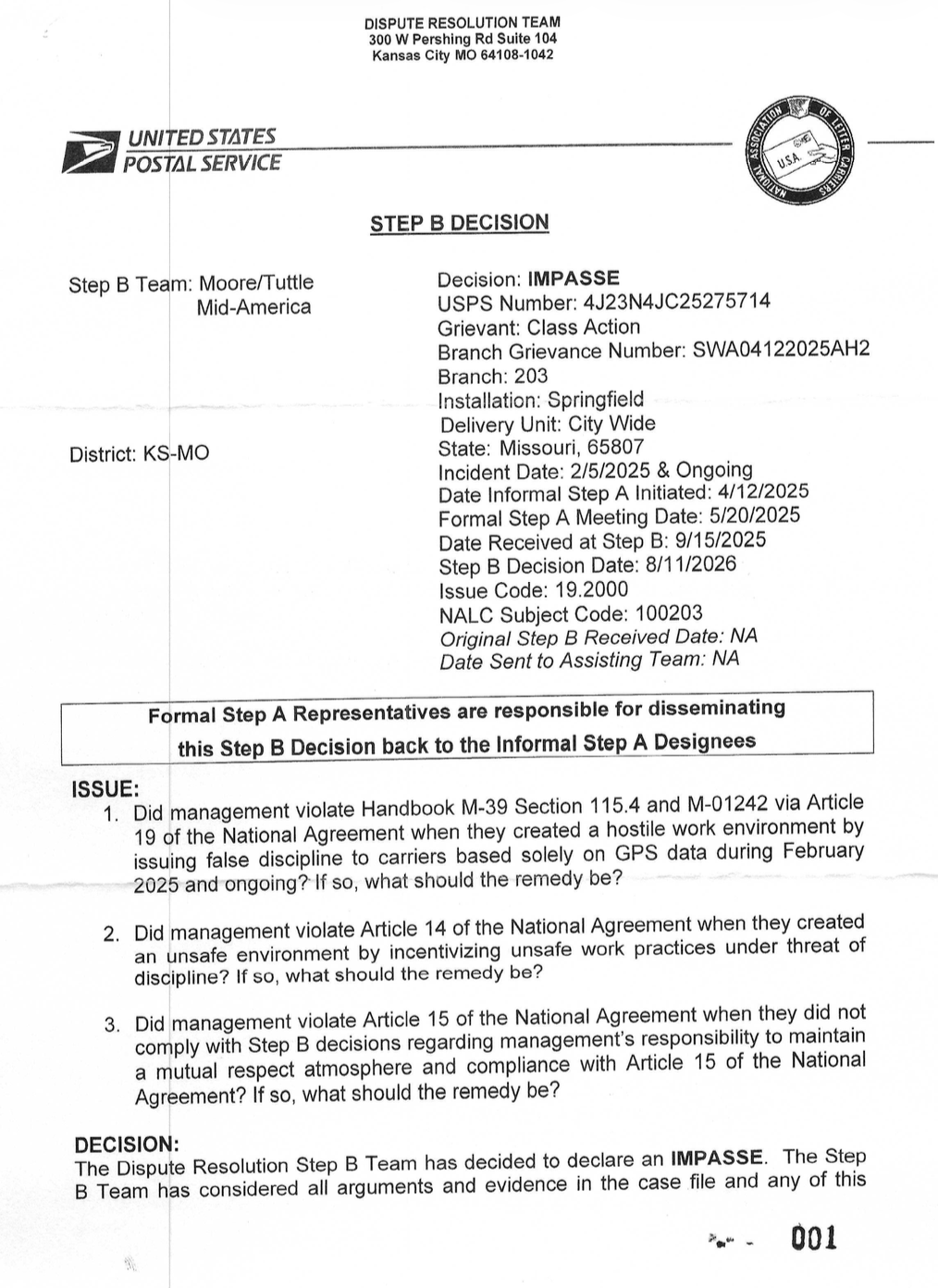
On page one we can see a few critical things. We can see the Step B team impassed the case (it got certified for arbitration), the installation being Springfield and the that it’s a city-wide issue, the incident date of 2/5/25 & ongoing, the Step B decision date of 8/11/26, and finally, the issue statements.
The issue statements tell us the union’s contractual framing of the problem. The issue statement is asked as a question, then the union must give evidence that supports the affirmative of the question. Here, the issues are threefold, so here’s a little explanation of the issues in context of the case:
1) The union asks if management made a hostile work environment by violating a couple provisions regarding mutual respect in the workplace and the Joint Statement on Violence and Behavior in the Workplace (M-01242). We ask this so we can support the question with a resounding “yes.” This is the first issue because it is the grounds for our next issue statement.
2) The union asks if management made an unsafe environment by issuing discipline under the pretense of “go faster or face discipline.” The union’s position is of course that creates an unsafe work environment, and we ask it so we can support it with another “yes.”
3) The union asks if management broke previous agreements to maintain an atmosphere of mutual respect that were agreed to through the grievance process. The union included several of these decisions into the case file to illustrate that management has agreed to treat carriers with dignity and respect. Again, we ask the question because the union’s position is “yes!”
It’s important to note that when it’s said “the union’s position,” that actually means YOUR position. YOU ARE the union, and together we say when enough is enough, and when false discipline is being issued to our union brothers and sisters to incentivize carriers to go faster or face discipline, YOUR position is “Hey, that’s not fair and not contractual.” The steward is just the one with the megaphone, you’re the crowd at their back showing there’s real support behind the movement. If we didn’t win all those stationary event grievances YOU would have been issued discipline to move faster or face discipline. We grieved it this way so the movement didn’t grow, and so far, we haven’t seen another stationary event-based piece of discipline.
All right, enough on page 1, let’s get moving.
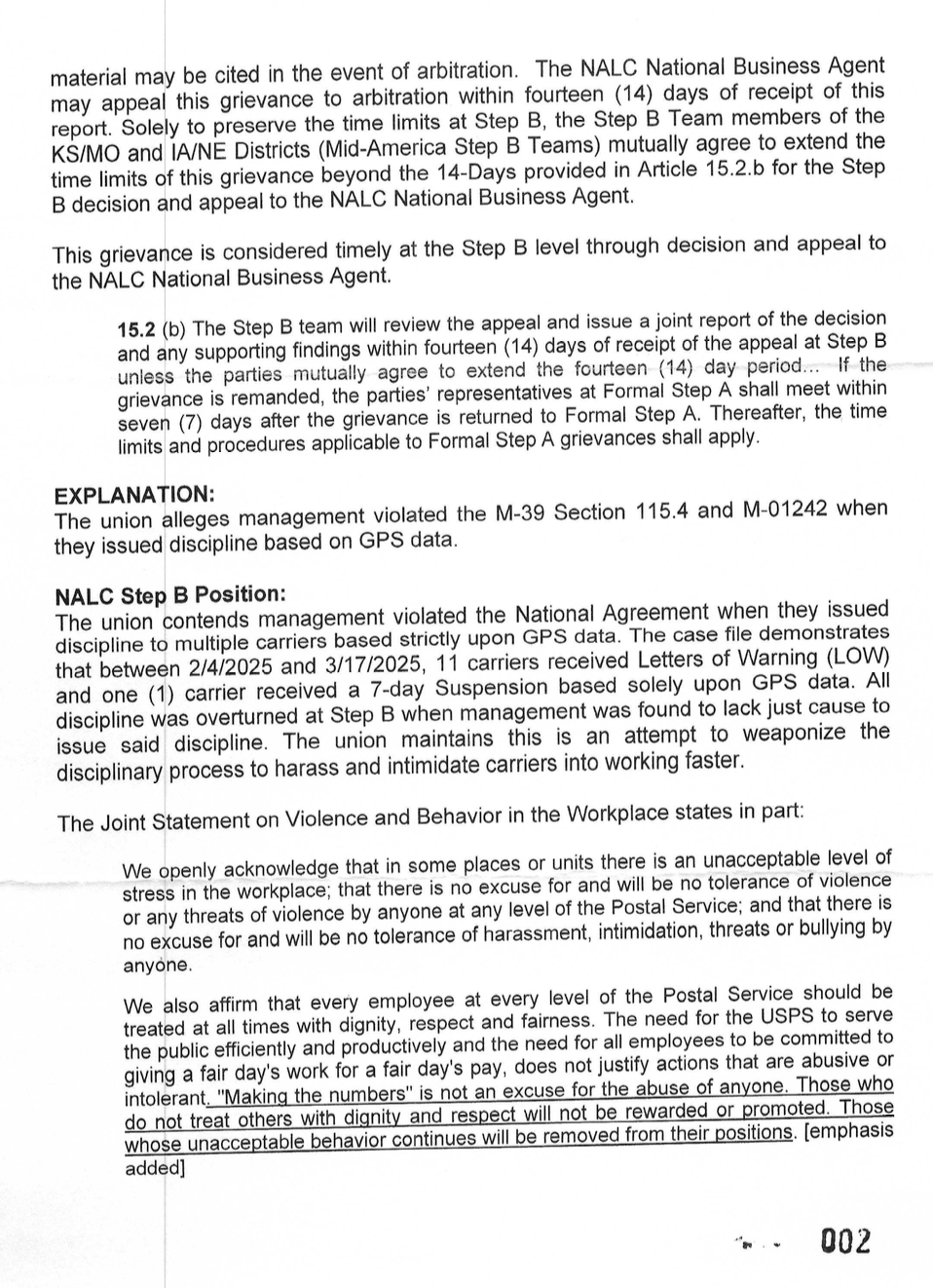
Page 2 the union comes out with the meat and potatoes: “The union maintains this is an attempt to weaponize the disciplinary process to harass and intimidate carriers into working faster.” This was my position at the informal and formal levels, and our Step B member held onto that position because he believed that case supported the position well enough. Big claim, but also big documentation to back it up. 12 carriers were issued discipline based on scanner data for being stationary in Springfield, and all of it was overturned. Check out that underlined text from M-01242, also called the JSOV.
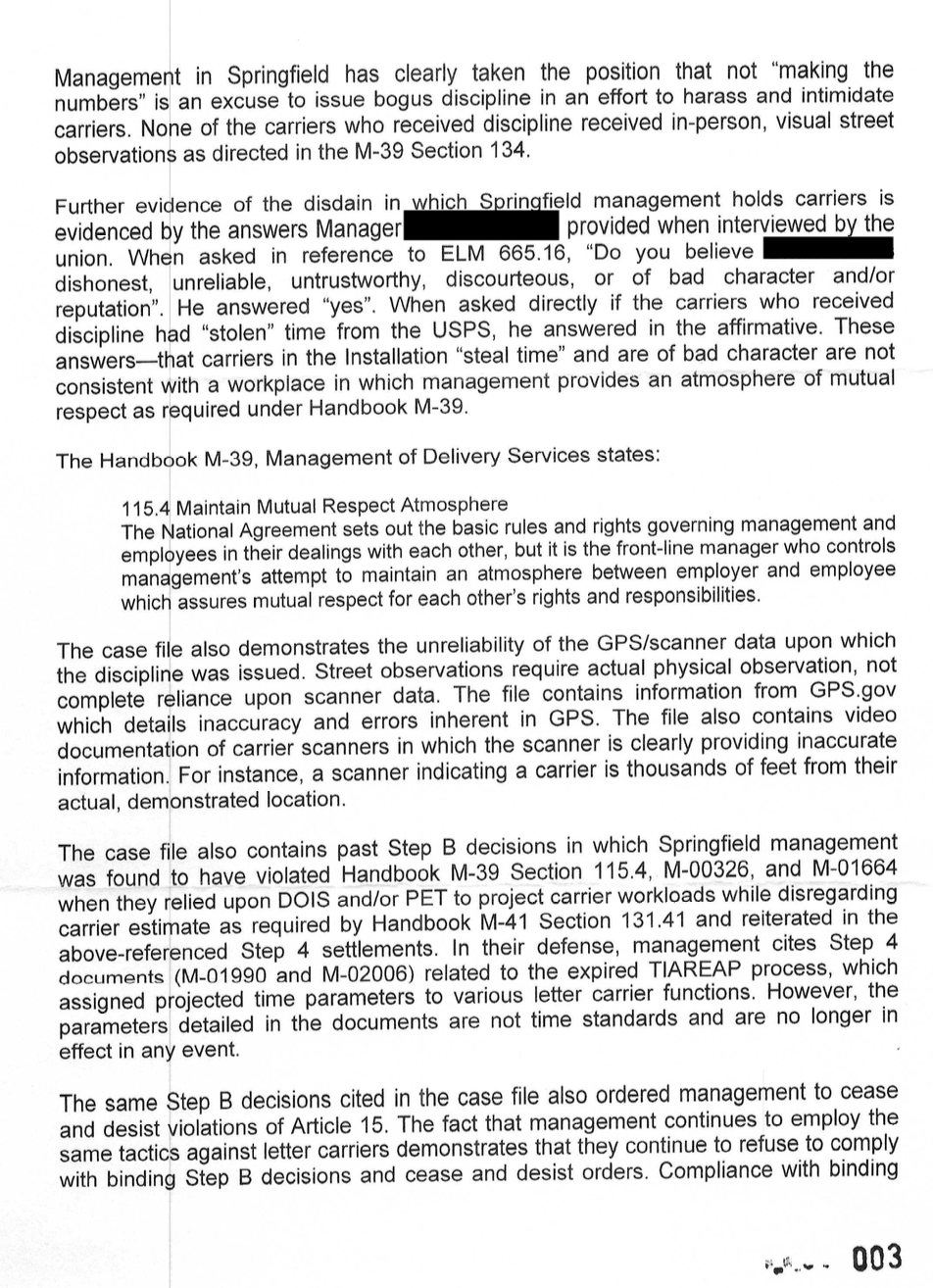
Page 3 the union hits several key points they can demonstrably prove. Management claimed carriers stole time form USPS for being stationary, even after the discipline was overturned through the grievance process. The union’s position is this shows letter carriers prejudice in the daily dealings of management, and illustrates management’s mentality towards the work of carriers.
Next, the union was collecting a bunch of scanner malfunctions via images and videos for this very reason. If you contributed an image or a video to me it went right here and people are seeing it. We used that to illustrate that USPS knows GPS data is faulty, USPS knows their equipment is faulty, and they’re attempting to make carriers accountable for it.
Next up, the union was able to show that management has abused carriers previously through their use of projection tools, 1017-B, and more. This supports the fact that management has attempted to take adverse action against carriers in an attempt to make them go faster. These Step B decisions document this isn’t the first time management has tried these tactics, but the discipline made it more systematic and egregious.
Lastly on page 3 we see that management has agreed to comply with previous decisions and agreed to cease and desist violations of those agreements, making them culpable for any deviation from agreements. In this case, the union is citing previous decisions that state management will maintain an atmosphere of mutual respect. We’re proving they have been told before to maintain an atmosphere of mutual respect, they’ve agreed to not go back on their word, and now they are going back on their word, tainting the grievance process.
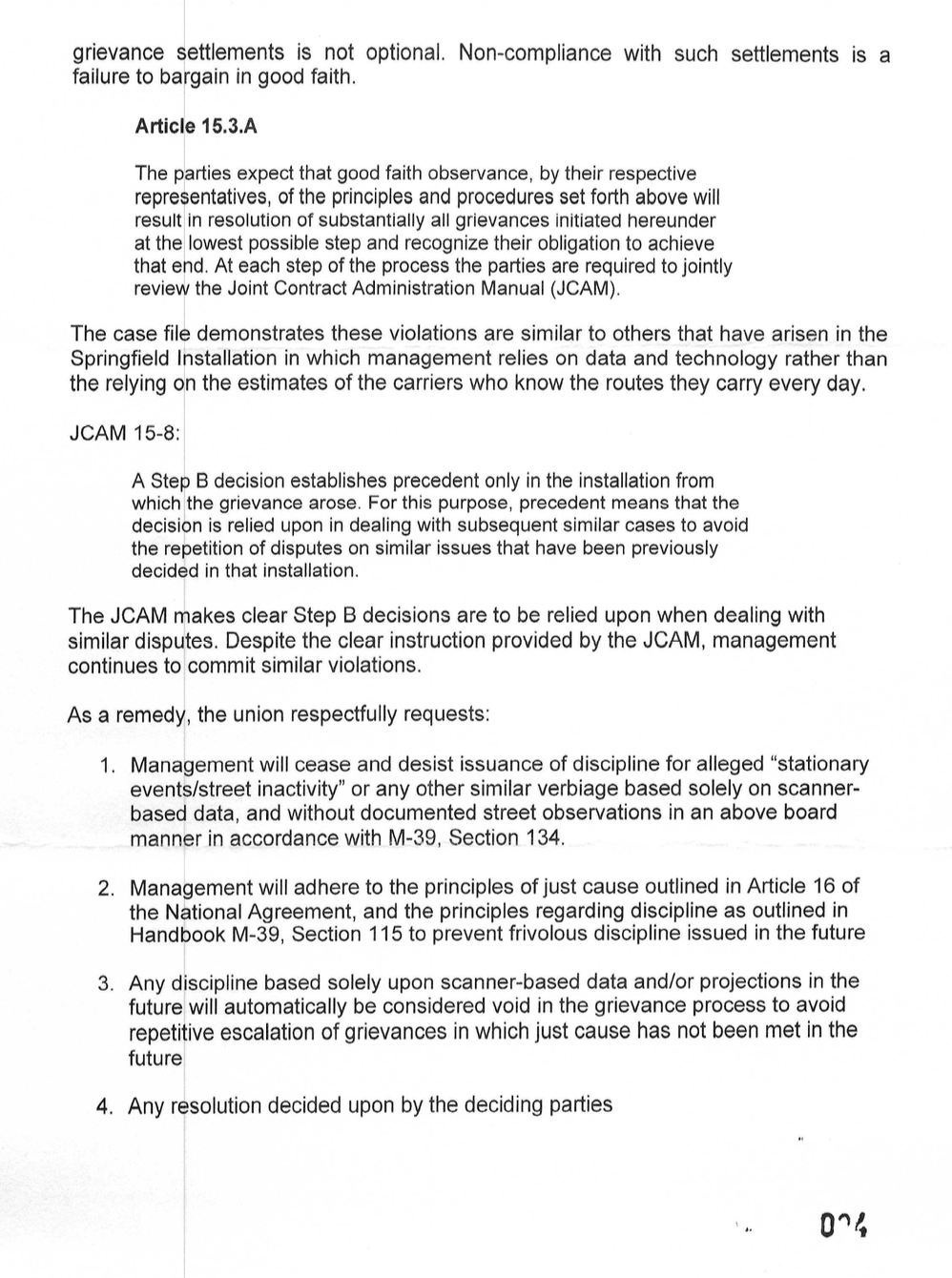
Page 4 cites violations of Article 15 of the National Agreement (the article that governs our grievance process), then ties decisions on management tactics we’ve grieved and won previously to the current issue. This is a reason our case is so strong here: we have lots of documentation on present conditions, documentation on a history of similar conditions, and documentation of management’s position which all support our claim of ongoing, systematic harassment to get carriers to “go faster or face discipline/adverse action.” When we have a case of alleged harassment, this is how tight we need to have the case. Harassment is not something that can just be bandied about or we’ll lose those cases and empower the behavior; we need to slow down and consider the processes to document our position for the case to be supported along the grievance procedure.
Lastly, page 4 outlines the terms of the remedy. We had systematic, procedural harassment, not interpersonal harassment, so the local union attacked the procedures of the discipline. The union’s remedy seeks to restrain how GPS data can be used, restricts management’s disciplinary issuance, and seeks to void any future discipline based on scanner data. These are no-brainers, and already baked in to various MOU and handbooks and manuals already, so why won’t management agree to it? Because they don’t want it on the record they must abide the principles of just cause, and they want to rely on scanner-based data in the future. The union sought a basic remedy that management should be able to agree with no problem, but knew they wouldn’t agree to the basics. This will enable the 4thremedy to stand stronger: “Any resolution decided upon by the deciding parties.” (Now this isn’t exactly what I requested, but they addressed it at the Step B this way for whatever reason they saw fit) If management won’t agree to follow proper procedures in the issuance of discipline, the odds the Arbitrator will put tighter constraints on them seems more likely because the union isn’t seeking to over-reach.
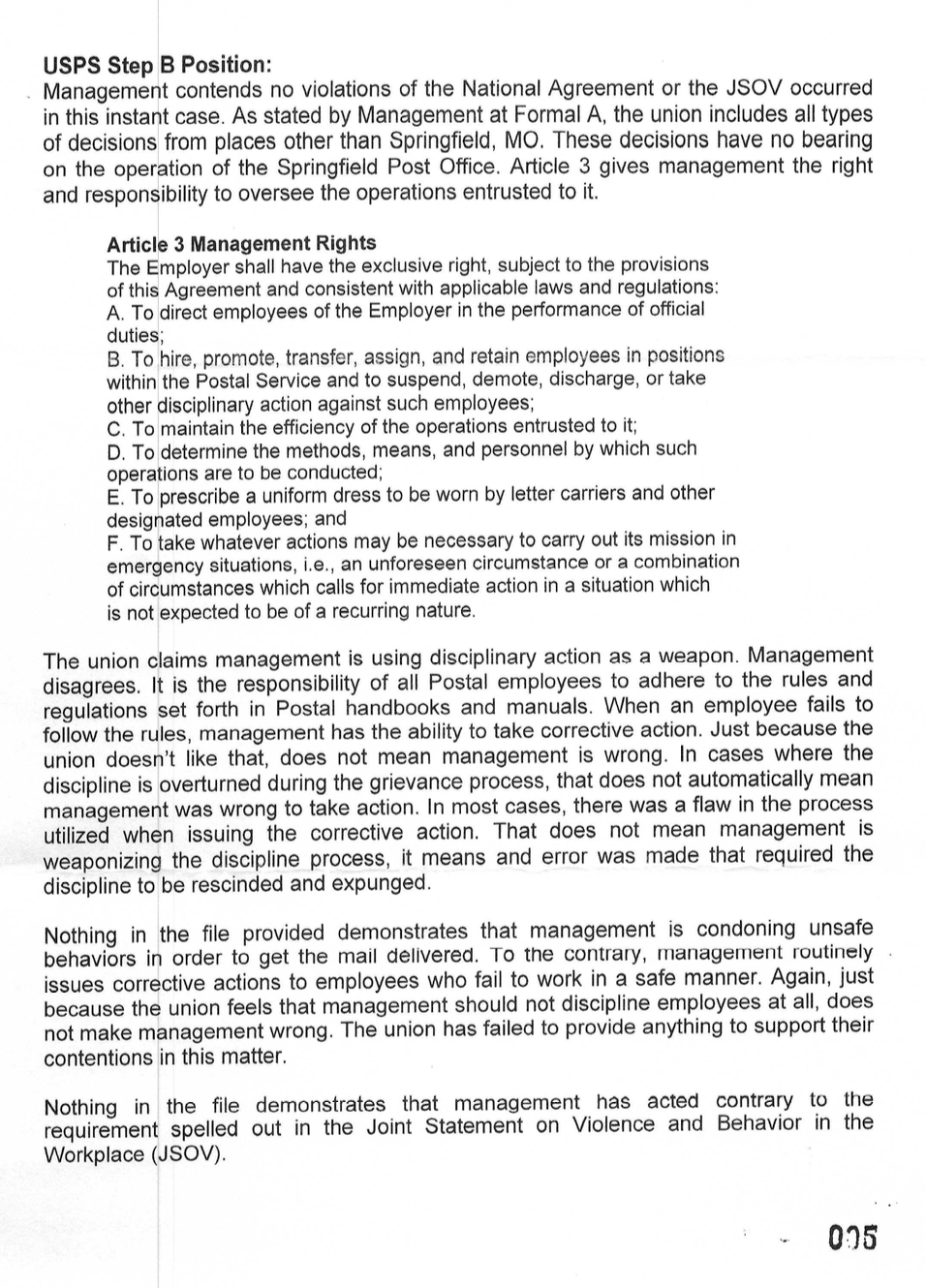
Page 5 begins management’s position, let’s pick it apart together.
First, management contends there were no violations. That’s expected for them to say, but how they try to support that is the flimsy part. They state decisions from other places that aren’t Springfield are used: correct, we relied upon national grievance resolutions and memorandums of understanding that apply to Springfield and any other place in the country. This defense doesn’t apply.
Second, management argues Article 3, which they always do. What they leave out is the part that says management’s rights are limited by the provisions of the National Agreement and related handbooks and manuals, essentially limiting their rights and responsibilities to what’s on paper. That part is in my arguments, rest assured. This argument was anticipated and nullified.
Third, management attempts to say that discipline is removed from carriers’ records for procedural defects. However, each piece of discipline the union cites confirms that management could not meet just cause, which shows there were no procedural defects, the discipline just didn’t stand up to scrutiny. This argument doesn’t apply.
Fourth, management states they are not condoning unsafe behaviors, however, I demonstrated that time carriers were being disciplined for was when they were delivering mail, taking their breaks, having comfort stops, and more. By discounting all this time management’s position became “any time a carrier is not moving they will be disciplined.” That helped our case for harassment A LOT. This argument was anticipated, so I went hard at it.
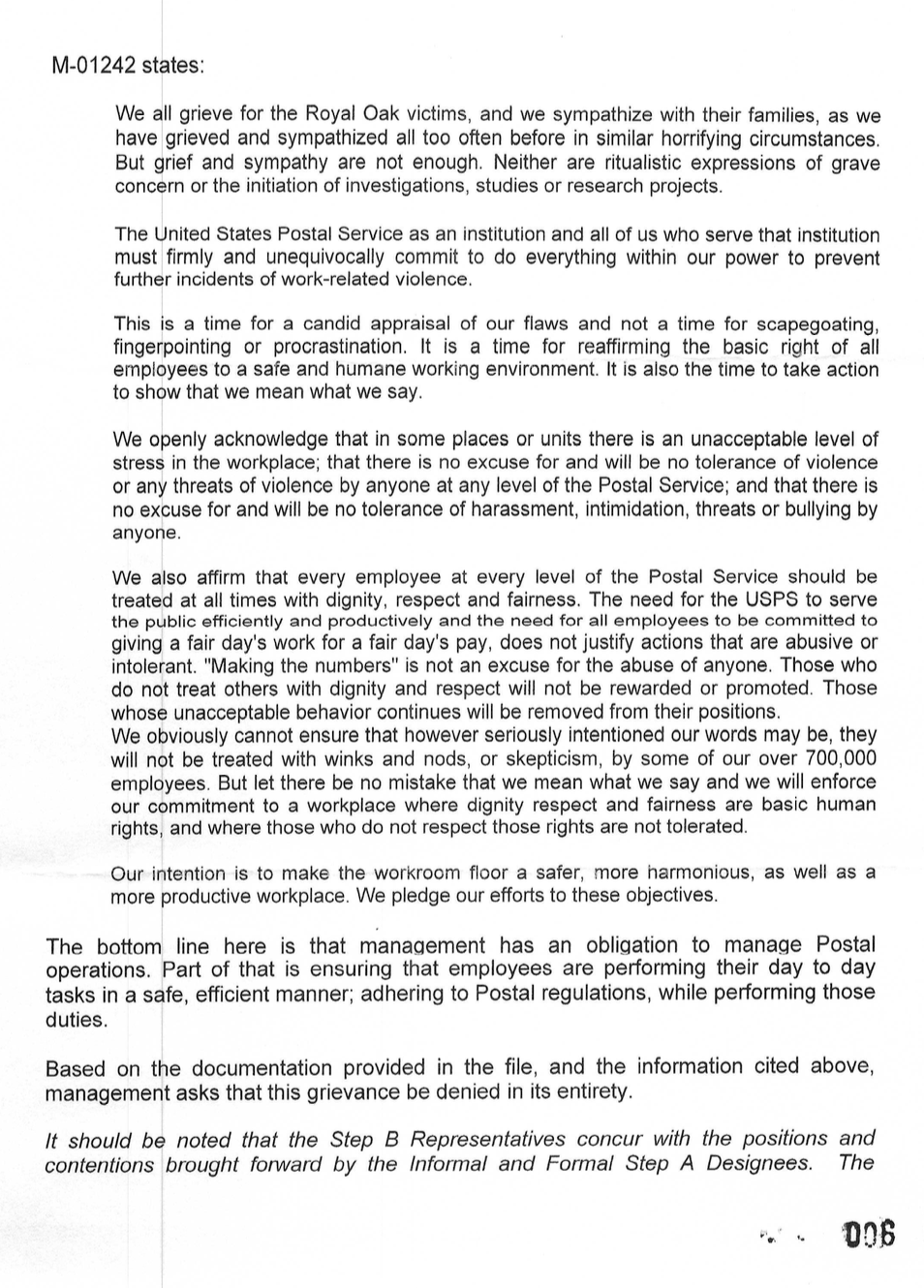
Page 6, management simply says there have been no violations of M-01242. Give that thing a read and you tell me.
Now, management HAS to deny a grievance when it comes to a claim of harassment or they’re saying, “Yes, we did do the harassing.” Of course they’re not going to do that, and to their credit, they’ve made the best arguments they can by saying, “No violations occurred.” In a contract case like this the burden of proof is on the union, so management just has to sit there and say “nuh-uh.” Nothing personal about that, that’s just part of the game. I don’t hold that against them, I hold the harassing behavior against them.
Then there’s an important part in italics there: the Step B reps concur with the positions of the informal and formal A designees. It’s important to know this Step B impasse is only a small portion of the case. The Formal positions are much denser as the Step B decision is just a synopsis, so here we see that reflected.
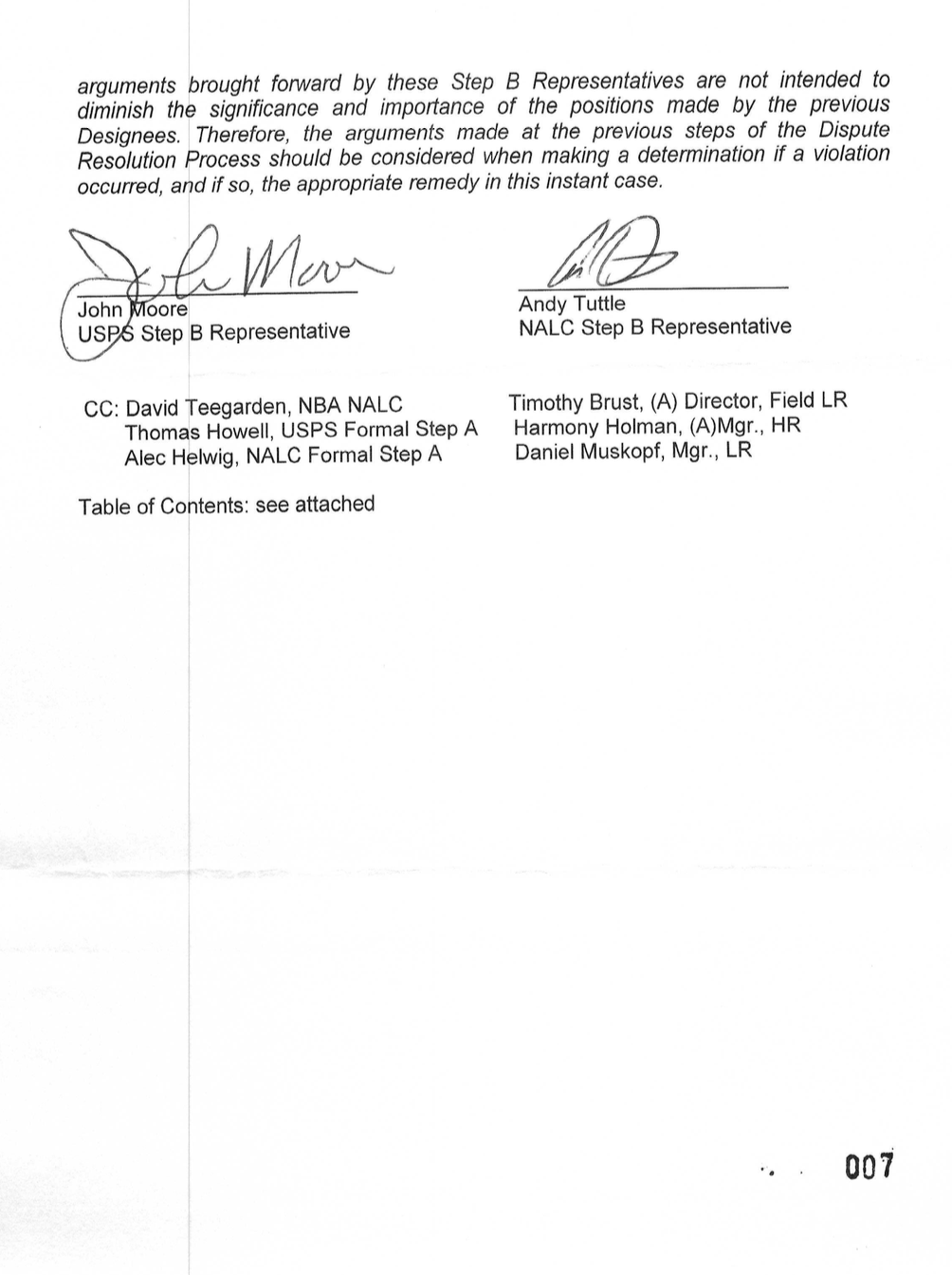
Page 7 has the boring stuff and signatures, but I thought it would be weird if I just didn’t post page 7. Let’s go to page 8.
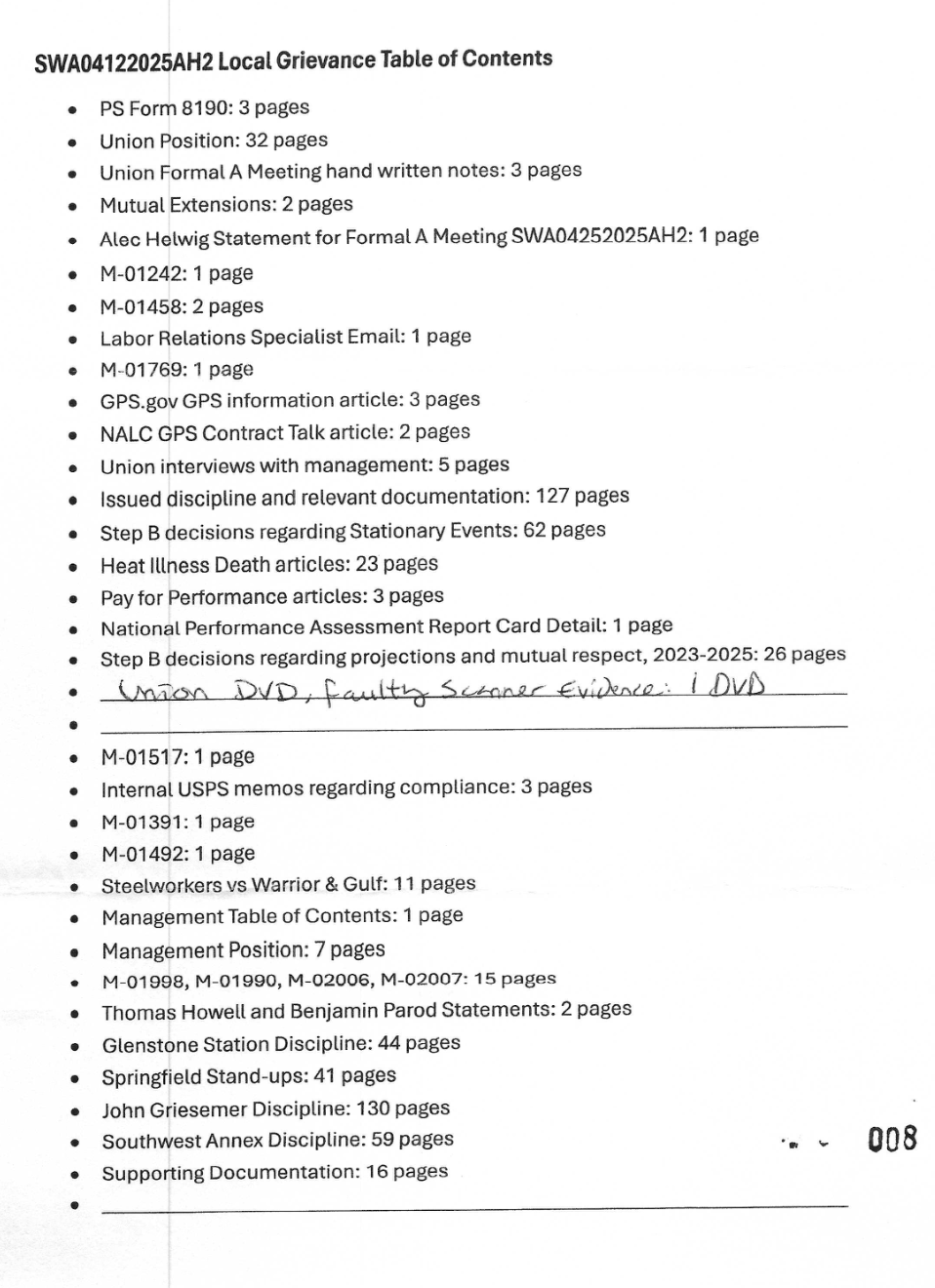
This is the table of contents that shows the work put in to the case. For scope, you can see the union’s position is 32 pages alone while the Step B is only 8 pages for both parties. There’s a lot of documentation going on here, but some of the highlights are:
- The union relied on a few Memorandums of Understanding, indicated by an M-XXXXX. These are national level documents that represent agreements between the parties that apply to everywhere in the country.
- The union relied on GPS.gov information about the inaccuracy of GPS data.
- The union relied on 127 pages of disciplinary documentation, and 62 pages of Step B decisions for Springfield to support their position of harassment.
- The union relied on 26 pages of Step B decisions for Springfield regarding mutual respect in the workplace.
- The union relied on a DVD full of images and videos of scanner malfunctions you all have sent me to cover your butts.
- Management relied on scads of discipline from each office to illustrate that carriers receive discipline and deserve disciplinary action. They did not include the grievance resolutions showing the discipline has been rescinded and expunged, reduced, or expired, they left all that part out.
This case was deemed strong enough to represent a city-wide harassment case by our National Business Agent at Arbitration, which is a good indicator that we’re onto something. All it took was a TON of evidence and documentation, as well as the right arguments. This has taken over a year to get where it is, which is absolutely ridiculous, and it will likely take another to get resolved.
That’s the Step B impasse in detail in its entirety. I hope you learned a few things about the grievance process, about the work that goes into building a case, and the documentation that it takes to support harassment. This is not in any way to discourage you from speaking up about harassment, it’s built to illustrate that when you make the claim, you begin a paper trail to support your claim.
If you have questions about harassment, reach out to a steward!
If you made it to the end, let me know next time you see me and I’ll give you 50 points. Take care and have a wonderful day.